Difference between revisions of "Template:Obelisks"
Commendatori (talk | contribs) |
Commendatori (talk | contribs) |
||
| Line 7: | Line 7: | ||
*** [[w:Roman triumph|Roman triumph]]: "a civil ceremony and religious rite of ancient Rome. Its origins and development remain obscure: ancient Roman historians placed the first triumph in the mythical past. The triumph publicly celebrated and sanctified the military achievements of an army commander who had won great military successes" | *** [[w:Roman triumph|Roman triumph]]: "a civil ceremony and religious rite of ancient Rome. Its origins and development remain obscure: ancient Roman historians placed the first triumph in the mythical past. The triumph publicly celebrated and sanctified the military achievements of an army commander who had won great military successes" | ||
*** "[http://www.masters-table.org/pagan/oblis.htm Obelisk's of the world]" | *** "[http://www.masters-table.org/pagan/oblis.htm Obelisk's of the world]" | ||
*** "[http://unixpapa.com/tower/ Grover's Guide to Campus Phallic Symbols]" | |||
*** "[http://www.rutajit.com/main/index.php?module=pagemaster&PAGE_user_op=view_page&PAGE_id=36&MMN_position=56:56 Be Fruitful and Multiply]" | *** "[http://www.rutajit.com/main/index.php?module=pagemaster&PAGE_user_op=view_page&PAGE_id=36&MMN_position=56:56 Be Fruitful and Multiply]" | ||
*** To research: [[w:Phoenician|Phoenician]] [[w:Bethel (god)|Beth-el]] ("house/stone of god"). See also: [http://www.valeriodistefano.com/gutenberg/html23/1/7/3/2/17328/17328-h/v8b.htm Betyle stone]. | *** To research: [[w:Phoenician|Phoenician]] [[w:Bethel (god)|Beth-el]] ("house/stone of god"). See also: [http://www.valeriodistefano.com/gutenberg/html23/1/7/3/2/17328/17328-h/v8b.htm Betyle stone]. | ||
Revision as of 01:38, 3 November 2010
- Various notes:
- The obelisk enacts the same formula as the pyramid - maximum height for minimum base - but in different material, leading to different scale and architectural setting. The tip of the obelisk might be covered in shining metal - gold or the gold-silver alloy electrum; this would catch the first ray of the sun just before dawn, dramatising the illuminating and life-giving power of the creator. These effects are specified in the inscriptions of New Kingdom obelisks, which also make clear the intimate relation of king and sun-god (see the pages on kingship on this website). [8]
- The obelisk consists of three trapezoids and a pyramid capstone. [9]
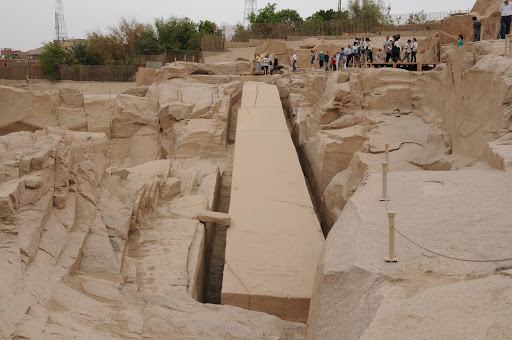
- Most often, pairs of giant monoliths of red granite from Aswan were erected in front of the massive double towers of a temple gateway. As a symbol of the sun, the creator-god of the ancient Egyptian pantheon, the giant obelisks marked the temple as a zone of sun worship. Therefore obelisks are not found in front of every temple, but only in temples associated with the sun-god. [10]
- See also:
- Occult symbolism: Phallus
- Roman triumph: "a civil ceremony and religious rite of ancient Rome. Its origins and development remain obscure: ancient Roman historians placed the first triumph in the mythical past. The triumph publicly celebrated and sanctified the military achievements of an army commander who had won great military successes"
- "Obelisk's of the world"
- "Grover's Guide to Campus Phallic Symbols"
- "Be Fruitful and Multiply"
- To research: Phoenician Beth-el ("house/stone of god"). See also: Betyle stone.
- The obelisk enacts the same formula as the pyramid - maximum height for minimum base - but in different material, leading to different scale and architectural setting. The tip of the obelisk might be covered in shining metal - gold or the gold-silver alloy electrum; this would catch the first ray of the sun just before dawn, dramatising the illuminating and life-giving power of the creator. These effects are specified in the inscriptions of New Kingdom obelisks, which also make clear the intimate relation of king and sun-god (see the pages on kingship on this website). [8]

Karnak obelisk, (near Luxor, Egypt)

Heliopolis obelisk (without hieroglyphs??), Saint Peter's Square, Vatican City (placed in 1586) (see also: Obelisks in Rome)

Heliopolis obelisk obelisk, Piazza del Popolo, Rome, Italy (placed in 1589)

Sanssouci obelisk, Potsdam, Germany (build in 1747)

Gamla stan, Sweden (build in 1800)

Heliopolis obelisk, Paris (placed in 1833 from Thebes, Egypt)

Bunker Hill Monument, Charlestown, Massachusetts, US. (build between 1827 and 1843)

District of Columbia obelisk (build between 1848-1884)
See also: [1]
(see previous)

(see previous)

Hyde Park Obelisk, Sydney, Australia (build in 1857)

Heliopolis obelisk, City of London (placed in 1878 from Alexandria, Egypt)

Heliopolis obelisk, New York (placed in 1881 from Alexandria, Egypt)

Bennington Battle Monument, Vermont, US. (build in 1889)

Buenos Aires obelisk, Argentina (built in 1936)

San Jacinto Monument, US (build in 1939)
Note the pentagram top and the nearby pyramid object. See also: [2].
Altamira, Caracas, Venezuela (build in 1944)

Obelisk of São Paulo, Brazil (build between 1944-1970)

Faro, Portugal (build in ?)

The Obelisk of Tuthmosis III, Istanbul, Turkey (build in ?)

Halde Hoheward, Germany (build in ?)

Messeturm, Frankfurt am Main, Germany (1991).
It is the second tallest building in Germany and the also the second tallest in the European Union.
? building in Singapore.
In the background is the Singapore Flyer ferris wheel.
The 2nd tallest obelisk in the world--2nd only to the Washington Monument, Phoenix Park , Dublin.
Note: The Phoenix is the Masonic animal by Excellence.
Obelisk Yad Vashem Holocaust Memorial-Jerusalem inside an six pointed star (surrounded by 6 hexagons) [3]


- Obelisk graves of the 'elite':

Obelisk grave marker of John D. Rockefeller

Obelisk gravestone of Thomas Jefferson

Obelisk gravestone of James Madison


- Black obelisks:

The Obelisk of Manishtushu found at Susa [4]

This black obelisk was erected by Assyrian king Shalmaneser III (858-824 BC). [5]

Black siltstone obelisk of King Nectanebo II of Egypt, Thirtieth dynasty, about 350 BC. According to the vertical inscriptions Nectanebo set up this obelisk at the doorway of the sanctuary of Thoth, the Twice-Great, Lord of Hermopolis.

Black obelisk in Munich

"This Obelisk, erected for Francis North of Guildford, is in memorandum of the exceptional hospitality shown to Frederick the Prince of Wales, most noble, during his stay at the Wroxton Abbey, September 1739" [6]

Obelisk in Elmwood Historic Cemetery on grave of successful banker and capitalist "J.J. Squier". [7]

Fritz Scholder's Obelisk at the National Museum of the American Indian- Washington DC

See previous



![[2]](http://wikicompany.org/wiki/Image:San_Jacinto_Monument_002.jpg)